Judicial Watch’s Historic Day at the Supreme Court
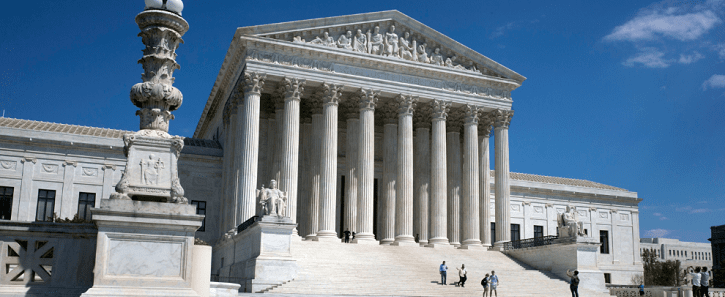
Judicial Watch was at the Supreme Court on Monday fighting for a critical legal determination: Election Day is a day—not five days, not a week, not a month.
“This is the most important Supreme Court election integrity case in a generation,” said Judicial Watch President Tom Fitton. “The pandemic spread of states counting late ballots received after Election Day is a flagrant violation of long-standing federal law that not only encourages voter fraud but also severely undermines public confidence in our elections. The Supreme Court now has a critical opportunity to restore a fundamental guardrail to the election process.”
More than fifteen states allow late-arriving ballots to be counted. Judicial Watch asked the Supreme Court to uphold a ruling by the U.S. Court of Appeals for the Fifth Circuit, which struck down as unconstitutional a Mississippi law allowing election officials up to five days to count mail-in ballots received after Election Day. Mississippi appealed, arguing that late-arriving, postmarked ballots were permissible.
The original JW lawsuit, brought behalf of the Libertarian Party of Mississippi, was later consolidated with a similar challenge by the Republican National Committee and others. At the court on Monday, former U.S. Solicitor General Paul Clement made the historic opening statement on behalf of Judicial Watch’s Libertarian Party client. “All agree that elections for federal office have to end on the day of the election specified by Congress,” Clement said. “…Nonetheless, Mississippi insists ballots can trickle in days or even weeks after Election Day.”
JW’s brief to the Supreme Court makes the case for a single Election Day. There is no historic foundation for counting ballots arriving after Election Day, JW notes, the opportunities for fraud are endless, and public confidence in elections is eroded.
“The whole point of the federal Election-Day statutes is to set a single uniform day for the election,” the brief notes. “Allowing ballots to trickle in days or weeks after Election Day is antithetical to that basic goal.”
Congress set an Election Day, not an Election Week or an Election Month. “Through the federal Election-Day statutes, Congress exercised its constitutional authority to set a uniform time for federal elections to occur. Text, historical practice, precedent, and common sense all demonstrate that those statutes set the deadline by which ballots must be submitted and received. Simply put, the ballot box closes on Election Day, and ballots that are not received until days or weeks after the date specified by Congress arrive after Election Day and should not be counted.”
It’s been a busy year for Judicial Watch at the Supreme Court. In January, the court granted standing in a historic case JW filed on behalf of Congressman Mike Bost and two presidential electors. The case challenges an Illinois law allowing the counting of ballots received up to fourteen days after the election.
The Judicial Watch election integrity team is led by Senior Attorney Robert Popper, who previously served in the Voting Section of the Justice Department’s Civil Rights Division. JW attorneys T. Russell Nobile and Eric Lee provide critical support for JW’s many landmark legal efforts.
On Monday, Tom Fitton reported from outside the Supreme Court after the hearing. The Judicial Watch team had made “historic legal arguments to preserve the idea of Election Day,” he said. Court observers were largely in agreement that a majority of the justices appeared poised to curb late-arriving ballots—though predicting what the Supreme Court will do is a fool’s errand. Some election officials are not waiting. On Thursday, the New York Times reported that election administrators in some states had already begun “planning for a world where all ballots must arrive by Election Day.”
A decision is expected in June.
#
Micah Morrison is chief investigative reporter for Judicial Watch. Tips: [email protected]
Investigative Bulletin is published by Judicial Watch. Reprints and media inquiries: [email protected]
Top News