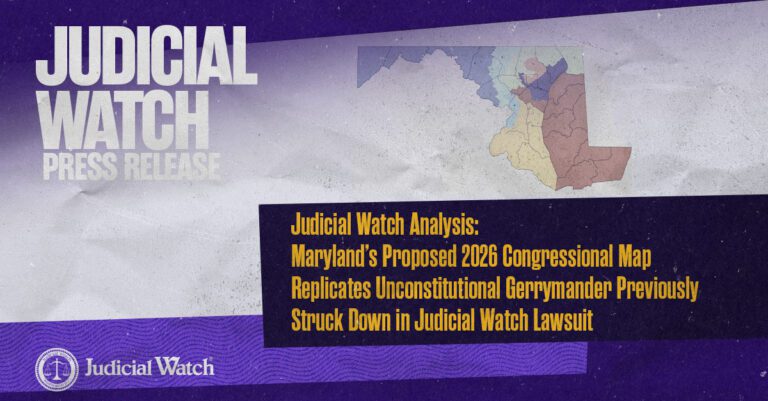
Judicial Watch Analysis: Maryland’s Proposed 2026 Congressional Map Replicates Unconstitutional Gerrymander Previously Struck Down in Judicial Watch Lawsuit
Proposed Map Is More Extreme Than the 2021 Plan Invalidated by Court; Targets Maryland’s Sole Republican District
(Washington, DC) – Judicial Watch announced today that a Democrat-proposed 2026 congressional redistricting plan for Maryland is in key respects identical to the unconstitutional gerrymander struck down in a prior Judicial Watch lawsuit—but is even more partisan and less compact than the invalidated 2021 map.
Judicial Watch’s analysis found that the proposed 2026 plan re-creates the same distorted configuration rejected by Judge Lynne A. Battaglia for Maryland’s First Congressional District, which shares 97 percent of the geographic area of the unconstitutional 2021 district. As before, the district again crosses the Chesapeake Bay Bridge to link disparate regions—an arrangement the court previously found unlawful.
The analysis also found that the proposed 2026 plan is less compact than both prior maps under all three compactness measures relied upon by Battaglia in invalidating the 2021 plan—directly violating the Maryland Constitution’s compactness requirement.
Additionally, the proposed redraw substantially increases county and municipal splits compared to the 2022 remedial map—another factor Battaglia cited in concluding the 2021 plan was an unconstitutional partisan gerrymander.
Using the widely accepted efficiency gap metric, Judicial Watch also determined that the proposed 2026 map is more partisan than both the 2021 map struck down as unconstitutional and the current 2022 remedial map now in effect.
Judicial Watch ascertained that the boundaries of Congressional Districts 2, 3, and 7 in Baltimore City closely track racial demographics, raising serious concerns about impermissible race-based districting.
Maryland is currently operating under a congressional map adopted in 2022, following Judicial Watch’s successful lawsuit on behalf of 12 registered Maryland voters. That suit challenged the state’s 2021 redistricting plan as an unconstitutional partisan gerrymander that diluted voters’ rights.
The current redistricting effort began in August after Governor Wes Moore suggested revisiting the state’s map amid national redistricting disputes. Republicans have warned that the proposal is designed to eliminate Maryland’s lone Republican member of Congress, Rep. Andy Harris—by resurrecting the same district configuration already ruled unconstitutional.
“This is a rerun of an unlawful gerrymander that a court already threw out,” said Judicial Watch President Tom Fitton. “Maryland Democrats appear determined to entrench partisan power at the expense of constitutional limits and voters’ rights. We are watching these developments closely.”
Judicial Watch is a national leader in election integrity and voting rights litigation, with a record of successful lawsuits enforcing constitutional redistricting standards and cleaning voter rolls nationwide.
Judicial Watch’s election law efforts are led by Senior Attorney Robert Popper, who previously served in the Voting Section of the Justice Department’s Civil Rights Division, where he managed voting rights investigations and litigation across dozens of states.
In January 2026, the Supreme Court of the United States ruled 7–2 in favor of granting standing in a historic case filed by Judicial Watch on behalf of Congressman Mike Bost and two presidential electors. The case challenges an Illinois law allowing the counting of ballots received up to 14 days after Election Day.
In November 2025, the Supreme Court granted review in a landmark election integrity case brought on behalf of the Libertarian Party of Mississippi. The case seeks to uphold a ruling by the U.S. Court of Appeals for the Fifth Circuit, which struck down a Mississippi law unconstitutionally allowing election officials to count mail-in ballots received up to five days after Election Day.
Federal courts in Oregon, California and Illinois have ruled that Judicial Watch’s lawsuits against those states to force them to clean their voter rolls may proceed.
Judicial Watch announced in May 2025 that its work led to the removal of more than five million ineligible names from voter rolls nationwide.
###
Top News