U.S. Invests $1.5 Mil to Help Salvadoran Police Deal with COVID-19 Stress
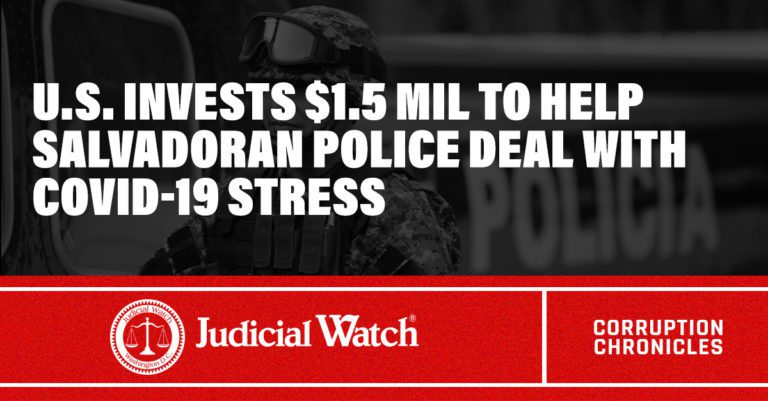
While local law enforcement agencies around the United States weather extensive budget cuts, the federal government is dedicating $1.5 million to assist police in El Salvador with challenges and stress created by COVID-19. The goal is to help the Central American nation’s 26,966-member National Civil Police (PNC) asses its role and capacities during a crisis and efficiently provide training to manage a public health emergency like the pandemic. “The training will particularly focus on public health orders, personal and workplace safety measures, education in regards to transmission and proper treatment, and management of operational continuity,” according to a grant announcement made public this month.
The document explains that in March 2020, the first case of COVID-19 was identified in El Salvador. With no immunity and no vaccine available to prevent infection in the impoverished country of about 6.5 million, COVID-19 has created challenges not only for the public health sector, but also for law enforcement agencies. To support Salvadoran law enforcement during the pandemic, American taxpayers will fund measures that will strengthen police programs to maintain control during lockdowns and enforce travel bans and social distancing rules. “The added support requirements created additional demands for security services and exposed police personnel to higher risk of infection,” the U.S. writes in the grant document. “In addition, because regular duties related to policing operations do not abate during the crisis, security sector personnel faced greater strain on resources and high levels of stress.”
Money for the initiative will flow through the State Department’s Bureau of International Narcotics and Law Enforcement Affairs (INL), which was created in the late 70s to reduce drug trafficking into the U.S. from Latin America. In fiscal year 2022 the State Department requested $456.8 million for INL programs it claims strengthen the rule of law, human rights protections, law enforcement capacity, anti-corruption activities, and other critical efforts around the globe. In this case the allocation will enhance El Salvador’s Ministry of Justice and Public Security’s capacity of preparedness for a public health crisis by efficiently providing essential public safety services, maintaining public order, and addressing additional challenges faced during such emergency. Among the requirements for grant recipients is that they identify stresses on officer wellness and police resources in the PNC, which stands for Policia National Civil in Spanish.
Back home in the U.S. police departments are enduring major budget cuts as part of a leftist movement ignited by George Floyd’s May 2020 death in Minneapolis. In the last year more than a dozen cities slashed police funding or decreased the number of officers, according to a probe conducted by a national news agency. They include the nation’s two largest cities—Los Angeles and New York—which eliminated $150 million and $1 billion respectively from their police budget. Other cities that drastically cut police funding include Austin, Seattle, San Francisco, Baltimore, Portland, Salt Lake City and Philadelphia. Washington D.C. decreased its police budget by $15 million. Predictably, there has been a rise in crime, motivating some cities to partially reverse police defunding. Even New York’s outgoing leftist mayor, Bill de Blasio, announced plans to reinstate $92 million for a new precinct and Oakland Mayor Libby Schaaf recently said she’ll work to reverse cuts to her city’s police department amid a spike in homicides and violence in the northern California city.
At the federal level, money keeps flowing to questionable foreign and domestic law enforcement initiatives. That includes $200,000 to advance “gender equality” in Costa Rica’s police forces by hiring more female cops. The funds also helped pay for the Central American nation’s first “institutional meeting of women leaders in gender matters” to help create a national agenda for the “empowerment of the police forces in the promotion of gender equity and prevention of gender violence in all its forms.” A few months ago a Clinton community policing program received $33 million from the government to advance a nationwide effort that includes tolerance, diversity, and anti-bias training as well as crisis intervention teams and de-escalation training. Former President Bill Clinton created the program, known as Office of Community Oriented Policing Services (COPS), to support “creative” approaches to preventing crime and promoting safe communities.
Top News