

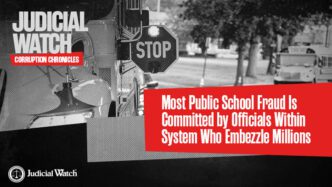
As the state of public education in the U.S. sinks to a historic low with consistent declines in math and reading scores, those hired by local governments to run the nation’s failing elementary, middle and high school campuses commit tens of millions of dollars in fraud. They include state and district superintendents, high-ranking school officials and lower level staff as well as charter school administrators. In the last five years alone, the public servants charged with educating children have operated at least 130 fraudulent schemes that have robbed schools of nearly $71 million. A new audit released by the Department of Education Inspector General (IG) calls them “bad actors” who were mostly exposed via a hotline portal operated by the watchdog. The probe resulted in 98 criminal and civil cases, 74 suspensions and 13 administrative actions. “Individuals who commit K–12 fraud frequently operate within the school system itself,” according to the Education watchdog. “These perpetrators have included State Superintendents of Education, charter school leaders, district superintendents and other high-ranking school officials, and school employees at all levels, as well as school vendors.”
Created by Jimmy Carter in 1979, the Department of Education (ED) is legally responsible for administering more than 100 programs and distributing billions of dollars annually to state and local education agencies, schools, organizations, and other entities that support students nationwide. However, the report says criminals target these programs each year, including special education, vocational rehabilitation, and Title I funds for school districts serving low-income families. Investigators found that these “bad actors”—insiders at taxpayer-funded schools across the country—abuse ED programs and intentionally misuse or embezzle funds meant to help students, schools, and teachers. Detecting the fraud is especially difficult because K–12 funding is decentralized across thousands of independent school districts around the country. Most federal education funds flow to state education entities, which then distribute money to local agencies, school districts, and individual schools. “Federal dollars are often blended with State and local funds and tracked through localized bookkeeping practices—which makes oversight more complex,” the new report reveals.
Evidently, this is why the ED watchdog relies heavily on complaints from individuals within school systems. That means the problem is surely much worse than the cases documented in the recently published report, which covers fiscal years 2020 through 2025. Investigations fell primarily within five categories: charter school fraud, public corruption, illicit schemes involving programs authorized under a decades-old law (Elementary and Secondary Education Act—ESEA) to provide disadvantaged students with a quality education, tutoring and academic support program fraud as well as scams involving emergency relief programs. The cases involving charter schools, which are publicly funded with no oversight, include embezzlement, inflated student enrollment numbers, ghost students or staff and fake invoicing schemes. Public corruption cases, which include abuse of position by school officials or employees for personal gain, uncovered bribery and kickback schemes, irregularities in contract awards and criminal conflicts of interest.
Embezzlement, misuse of funds and false representation were the key offenses committed by public officials running school programs funded under ESEA, which delivers financial assistance to districts and campuses that serve children from low-income families. Only six percent of the stolen money has been recovered, however. Taxpayer-funded tutoring and academic support programs for primarily students in high-poverty, low-performing schools were also raided by crooked education officials who embezzled funds, filed false invoices and reported ghost students to collect more money. As for emergency relief, Congress provided billions of dollars in funding to help K-12 schools and districts nationwide meet the educational needs of students affected by hurricanes and wildfires and billions more during the coronavirus pandemic, making the broad cash giveaway an easy target for corrupt educators. The audit found that those crimes “predominately involved false claims, mismanagement, or misuse of funds.”