

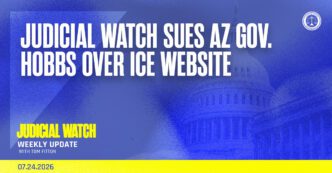
Judicial Watch Sues AZ Gov. Hobbs over ICE ‘Know Your Rights’ Website
California Seeks to Revive Failed Corporate Board Gender Quota
FBI Received Faxes ‘Claiming Credit’ for TWA Flight 800
Despite Rampant Fraud, U.S. Gives Kyiv $10 Million to Combat HIV
Judicial Watch: Fighting for Election Integrity
Judicial Watch Sues AZ Gov. Hobbs over ICE ‘Know Your Rights’ Website
In October 2025, we filed an Arizona Public Records Law lawsuit against Gov. Katie Hobbs for records regarding her office reportedly ordering state police and the Arizona National Guard to withhold cooperation from federal immigration enforcement authorities (Judicial Watch Inc. v. Office of the Arizona Governor (No. CV2025-039217)).
Our investigation of her antics continues. We filed another Arizona Public Records Law lawsuit against Hobbs for records regarding the costs and communications associated with her administration’s launch of a “Know Your Rights” web portal advising Arizonans on interactions with Immigration and Customs Enforcement (ICE) and other federal law enforcement officials (Judicial Watch Inc. v. Katie Hobbs (No. CV2026-029456)).
We sued in Maricopa County Superior Court after the Governor’s Office failed to produce records in a February 2026 public records request about the development of the “knowyourrights.az.gov” website, as well as documents supporting claims made by the Governor’s Office regarding alleged violations of Arizonans’ rights by federal law enforcement.
The request further seeks communications between the Governor’s Office and immigration advocacy organizations and individuals, including Aliento Education Fund, Arizona Center for Empowerment (ACE), Living United for Change in Arizona (LUCHA), Proyecto Progreso, Raquel Terán, Reyna Montoya, and Lena Avalos.
In a February 4, 2026, press release, Hobbs’s office announces the launch of the web portal “to inform Arizonans of their constitutional rights when engaging with federal law enforcement or in peaceful protests.” Hobbs states in a videoincluded in the release, which also appears on the website, “I share the fear and anger of many Arizonans who, over the past year, have seen far too many instances of federal agents denying us our right to peaceful protest …”
The launch of the website follows Hobbs’s April 2025 veto of the “ICE Act” (Senate Bill 1164), which AZ Senate President Warren Petersen described as “a reasonable, commonsense proposal supported by Arizona sheriffs to ensure all levels of law enforcement were working with the federal government to enforce our laws and protect our citizens from harm.”
Governor Hobbs is using taxpayer resources to promote a website built around claims about federal law enforcement, yet her administration refuses to provide the public with basic information about its costs, development, and the records supporting those claims.
California Seeks to Revive Failed Corporate Board Gender Quota
A California court permanently enjoined California’s secretary of state from spending taxpayer money to implement a law requiring a certain number of women on corporate boards because it violates the California Constitution’s equal protection clause.
But Gov. Gavin Newsom’s secretary of state, Shirley N. Weber, decided differently and launched a flawed appeal.
In response we filed a 90-page brief in the California Court of Appeal, defending the trial court ruling striking down Senate Bill 826 (SB 826), the state’s controversial law requiring publicly held corporations headquartered in California to meet government-imposed gender quotas on their boards of directors. Our brief urges the Court of Appeal to uphold the lower court’s decision because the law violates the California Constitution’s equal protection clause:
After 27 days of trial, 16 witnesses, 174 exhibits, and a trial transcript that spans over 8,500 pages, the Secretary was unable to convince the trial court that SB 826’s gender-based quota satisfies one of the toughest standards the law imposes—strict scrutiny. The law has multiple failings, not the least of which is that it was never intended to remedy alleged patterns and practices of discrimination in the board selection processes of some 625 publicly held corporations headquartered in California.
The trial court concluded that the state failed to justify the quota under the constitutional standard required for laws classifying individuals based on sex. California now asks the Court of Appeal to overturn that ruling and revive the quota law.
We filed the gender quota lawsuit in Los Angeles County Superior Court in 2019 on behalf of three California taxpayers. The lawsuit challenged the 2018 law, which mandated every publicly held corporation headquartered in California to have at least one director “who self-identifies her gender as a woman” on its board of directors (Robin Crest et al. v. Alex Padilla (No. 19ST-CV-27561)).
Our appellate brief argues that California abandoned many of the justifications it previously relied upon to defend the law and now is attempting to recast SB 826 as legislation intended to remedy discrimination—an argument that failed at trial.
Our brief argues:
The law was sold to the Legislature … as a way to increase women’s representation on corporate boards, if not achieve gender parity, and thereby boost the California economy and protect taxpayers, shareholders, and retirees. Because gender parity, economic benefits, and protecting taxpayers, shareholders, and retirees have never been compelling government interests under strict scrutiny, the Secretary needed another justification for the law when it was challenged in court. But because the legislative groundwork for a “remedying discrimination” compelling state interest had not been laid—and never could be laid—that effort failed. It should have come as no surprise then that the Secretary was unable to defend the law’s gender-based quota, despite having every opportunity to do so.
The brief also asserts: “By several measures, the number of women on the boards of California’s publicly held corporations was increasing before SB 826’s passage … ”
The trial court specifically rejected the secretary’s claim that the purpose of SB 826 was remedying discrimination and found as a factual matter that the actual purpose was “gender equity or parity,” “gender balancing,” and getting “more women on boards.”
The brief also argues that the secretary cannot refute “that SB 826 is not actually remedial.”
She makes no effort to show that SB 826 was “designed as nearly as possible to restore the victims of specific discriminatory conduct to the position they would have occupied in the absence of such conduct,” … Indeed, “[t]he lack of any effort to limit the benefits of a remedial scheme to those who actually suffered from specific discrimination will be fatal to the scheme.”
The brief also argues, “SB 826 plainly is a quota, and a rigid one at that…. The secretary’s own expert described SB 826 as a quota. One legislative report called it ‘essentially a quota system for private corporate boards.’”
Here, the trial court found no proof that California directly or passively participated in California corporations’ unlawful discrimination against women in board selection or that California corporations even engaged in such discrimination. It also found that SB 826 made no meaningful effort to connect the law’s quota to identified victims of specific wrongdoing, among its many other failings.
California continues to waste taxpayer dollars defending the indefensible – an unconstitutional gender quota scheme imposed on corporations that only serves to help corporations virtue signal about hiring women for their boards through government-mandated quotas.
The trial court correctly concluded the state failed to satisfy the demanding constitutional standards required for government discrimination based on sex. The Court of Appeal should affirm that ruling and reject California’s attempt to rewrite the purpose of the law after losing at trial.
In 2020, we filed a separate taxpayer lawsuit in Los Angeles County Superior Court challenging Assembly Bill 979, which Governor Gavin Newsom signed into law on September 30, 2020. That law mandated racial, ethnicity, sexual preference and transgender status quotas for corporate boards. On April 1, 2022, the Superior Court issued a ruling and opinion striking down Assembly Bill 979’s quotas and granting a permanent injunction prohibiting the secretary from spending taxpayer money on the unconstitutional law.
FBI Received Faxes ‘Claiming Credit’ for TWA Flight 800
We have serious questions about a 30-year-old tragedy.
We received 415 pages of records in a Freedom of Information Act (FOIA) request from the Federal Bureau of Investigation (FBI) which show the Bureau received faxes claiming credit for the July 1996 explosion of Trans World Airlines (TWA) Flight 800.
An FBI New York Field Office electronic communication in case file 265A-NY-259028 was issued on July 19, 1996, just two days after the July 17, explosion of TWA Flight 800. The four-page document was sent with “Immediate” priority to the “FBI Director,” “All FBI Field Offices,” and “All Legats.” Titled “UNSUB(S); EXPLOSION OF TWA FLIGHT 800, 29 MILES SOUTHEAST OF HAMPTON, NEW YORK; JULY 17, 1996; AOT – IT – EOD; OO: New York,” it states: “FBI headquarters is in receipt of faxes generated from Cairo claiming credit.”
Boeing 747-131 was bound for Paris from John F. Kennedy International Airport in New York City. All 230 people died, including 212 passengers and 18 crew members.
To mark the 30th anniversary of the TWA Flight 800 crash, Judicial Watch released a special investigative documentaryon social media.
In “Judicial Watch Investigates TWA 800 — 30 Years Later,” a special edition of its “On Watch” series, Judicial Watch examines the full record of the air disaster. The documentary includes interviews with experts with extensive knowledge of the tragedy; interviews with witnesses; FBI records we obtained by FOIA, including the July 1996 teletype stating the Bureau received faxes from Cairo claiming credit for the disaster; and publicly available documents.
The official explanation for the TWA 800 crash includes a controversial CIA animation concluding that the middle fuel tank was somehow ignited and caused the crash. The CIA production dismisses the accounts of dozens of witnesses who saw a streak of light rise up to the plane before it exploded.
The documentary covers:
- The human story — 230 killed, including 16 Montoursville, Pennsylvania high-school French-club students.
- The FBI overriding the National Transportation Safety Board (NTSB) from the initial hours of the investigation.
- The NTSB’s unresolved theory of an ignition source (“most likely” a short circuit, never located or recreated).
- How no Boeing 747s were grounded for blanket inspections or repairs immediately following the 1996 explosion of TWA Flight 800.
- How no 747 before or since the July 1996 crash has ever suffered the catastrophic explosion of TWA 800.
- The Central Intelligence Agency’s (CIA’s) nationally televised “witness perception” animation — from an agency with no aviation-accident role.
- The explanation by the FBI and NTSB that traces of explosive materials found on recovered parts of TWA 800 were from a K-9 training exercise.
- The 755 witness reports — 183 describing a streak of light, 96 of those placing its origin at the surface — none permitted to testify.
In our investigation of the TWA Flight 800 tragedy, in March 2026 we filed 13 FOIA requests across eight federal agencies, including the FBI (six requests), NTSB, CIA, U.S. Department of Justice Criminal Division, U.S. Navy, U.S. Coast Guard, National Archives and Records Administration (NARA)/Clinton Library, and National Reconnaissance Office (NRO).
In May 2026, we announced a FOIA lawsuit against the CIA for records regarding the agency’s involvement in the investigation of the crash of TWA Flight 800, including the decision to produce a witness perception animation that purportedly demonstrated how witnesses could have mistaken the visual effect of the exploding aircraft for a missile launch.
“Judicial Watch Investigates TWA 800 — 30 Years Later” can be viewed on YouTube here.
After 30 years, we forced the release of a previously secret FBI document that raises questions about TWA Flight 800. The mysteries around the crash deserve a renewed investigation, as our new documentary demonstrates.
Despite Rampant Fraud, U.S. Gives Kyiv $10 Million to Combat HIV
Yes, Ukraine is notoriously corrupt, but that doesn’t stop State Department bureaucrats with their hands on your tax dollars. Our Corruption Chronicles blog looks at one wasteful program.
Although the Trump administration plans to drastically slash funding of HIV programs in the United States in the coming year, it is allocating $10 million to combat the sexually transmitted disease (STD) in Ukraine, which already gets an exorbitant amount of aid from American taxpayers. Congress has allocated an astounding $195 billion in spending to the war in Ukraine and though most of it goes to military causes a big chunk has gone to humanitarian projects rife with corruption. Judicial Watch launched an investigation after a federal audit exposed fraud in the government’s extensive Ukrainian humanitarian aid initiative and last year sued the notoriously corrupt State Department offshoot known as U.S. Agency for International Development (USAID) that disbursed some $35 billion in aid to the former Soviet republic since the Russian invasion in 2022.
Some of that money went to failed HIV programs in Ukraine that were later involved in criminal activity, a point of concern that should stop the flow of U.S. taxpayer dollars. A few years ago, Judicial Watch exposed one of the fraudulent Ukrainian HIV charities that received tens of millions of dollars from Uncle Sam as well as generous contributions from leftwing billionaire George Soros. It was known as 100% Life and its purported mission was to fight for the life of people living with HIV in Ukraine’s 25 regions. But the Ukrainian HIV charity also helped another group embezzle international assistance and authorities launched an investigation that exposed a broad illicit scheme. The head of 100% Life’s board of directors, HIV-infected activist Dmytro Sherembey, was also investigated. A year earlier he published a book about AIDS that promotes the legalization of sex work and illicit drug use without punishment. Long before the Russian invasion, corruption in Ukraine robbed HIV patients of crucial medicine, according to various reports published by news outlets and international human rights groups.
There is no indication that anything has changed as the U.S. announces the latest grant to help the eastern European nation combat an epidemic of HIV, which has reportedly intensified since the war began. The Centers for Disease Control and Prevention (CDC), which is part of the Department of Health and Human Services (HHS), will distribute the $10 million award to help the war torn nation’s inadequate Public Health Center (PHC) and Ministry of Health (MOH) enhance life-saving assistance for HIV conditions. The objective is to ensure that targeted HIV testing, treatment, retention and prevention services are widely available, according to the grant announcement issued this month.
“Since February 2022, the global HIV program in Ukraine has encountered unprecedented challenges,” the document states. “Amid the ongoing war, it’s been especially challenging to meet the expanding needs of people at higher risk for HIV. The destruction of Ukrainian health and other key infrastructure has created a substantial risk of service interruptions and devastating challenges in availability of life-saving services.”
The money will fund innovative, data-driven models and interventions for high-risk HIV populations, community services that help the infected adhere to treatment and address gaps in availability and use of essential life-saving HIV prevention services, among other things. High-risk HIV populations are described as people who inject drugs and their partners, people in prisons and other closed settings, those with high-risk sexual behavior and their partners as well as the displaced. The U.S. counts community-based HIV testing, linking the infected with care and using social network testing strategies to find those infected as past achievements in combatting Ukraine’s HIV crisis. It also lists complicated access to high-risk HIV populations due to security reasons, patients dropping out of treatment and late HIV diagnosis as its biggest challenges. “Amid the ongoing war, it’s been especially challenging to meet the expanding needs of people at higher risk for HIV,” the CDC grant document states. “The destruction of Ukrainian health and other key infrastructure has created a substantial risk of service interruptions and devastating challenges in availability of life-saving services.” People at higher risk of HIV need even more intensive support since the war began, the CDC claims.
Judicial Watch: Fighting for Election Integrity
We are a preeminent national force for clean elections, as Micah Morrison, our chief investigative reporter, describes in Investigative Bulletin.
In the fight for election integrity, Judicial Watch continues to notch voter-friendly victories across the country.
In California, Judicial Watch sued the state for failing to maintain accurate voter rolls—a requirement of the National Voter Registration Act. The law requires the removal of most inactive voter registrations after two general elections. The numbers are astonishing. The JW lawsuit charges that California failed to remove 873,000 inactive voters from their registration rolls who have been inactive for more than two general elections. Sometimes a lot more: tens of thousands of the registrations have been inactive for over ten years. The lawsuit was filed on behalf of the American Independent Party of California and Don Wagner, an elected member of the Orange County Board of Supervisors who is running for California Secretary of State.
Last week, the Justice Department filed notice that it intended to intervene in the lawsuit on behalf of Wagner and the Independent Party. Citing data from Judicial Watch’s original complaint, the Justice Department said in itsComplaint in Intervention that California “does not comply with the NVRA’s requirement that the state conduct a general program of voter registration list maintenance that makes a reasonable effort to remove persons from the voter rolls who have become ineligible.”
JW President Tom Fitton welcomed the federal move. Dirty voter rolls can mean dirty elections. “The Justice Department is right following Judicial Watch’s lead and join our fight to clean up California’s dirty voting rolls,” Tom said.
This isn’t Judicial Watch’s first election-integrity rodeo in California. In 2019, Los Angeles County settled a JW lawsuit that resulted in the removal of more than 1.2 million names from voter rolls.
In April, Judicial Watch announced a historic milestone—the removal of six million ineligible names from voter rolls nationwide. In Colorado, 372,000 ineligible voter names were removed from voter registration lists following a lawsuit and settlement. In the settlement, Colorado agreed to a sweeping voter roll cleanup, with extensive follow-up and reporting. In Oregon, Judicial Watch reached a settlement in its federal lawsuit against the state. Oregon officials confirmed that 800,000 ineligible voter names are slated for review and removal from voter registration lists.
In June, Judicial Watch came close, but ultimately lost, an election integrity case before the U.S. Supreme Court. Judicial Watch led the effort to uphold Election Day at the Court. We represented the Libertarian Party of Mississippi in the case, arguing that a single day for Election Day should be enforced and the counting of ballots that arrive after Election Day be prohibited. In our brief to the Court, we argued that “the whole point of the federal Election-Day statutes is to set a single uniform day for the election.
Allowing ballots to trickle in days or weeks after Election Day is antithetical to that basic goal.” In its July 2ruling, a closely divided Court declined to uphold a single, uniform Election Day. Tom called the 5-4 decision “astonishing.”
But in January, the Supreme Court ruled 7–2 in favor of granting standing in a historic case filed by Judicial Watchon behalf of Congressman Mike Bost and two presidential electors. The case challenged an Illinois law allowing the counting of ballots received up to fourteen days after Election Day. The landmark ruling in the Bost case established an important principle, affirming the rights of a political candidate to bring election-ballot disputes to federal court.
Until next week,