

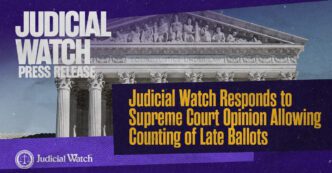
(Washington, DC) – Judicial Watch President Tom Fitton made the following statement regarding today’s “astonishing” 5–4 Supreme Court decision in Judicial Watch’s landmark election integrity case, which failed to uphold the Election Day established by federal law and declined to require states to reject ballots that arrive after Election Day. Judicial Watch represented the Libertarian Party of Mississippi before the Supreme Court, arguing that the court should enforce Election Day and prohibit the counting of ballots that arrive days after Election Day (Watson v. Republican National Committee et al. (No. 24-1260)) (Libertarian Party of Mississippi v. Wetzel et al. (No. 1:24-cv-00037)). Fitton stated:
The Supreme Court’s astonishing 5–4 decision further eviscerates the very notion of Election Day and threatens to make a mess for our nation’s already stressed federal elections. The decision is contrary to the plain words of federal law establishing Election Day, invites significant voter fraud, and will further undermine voter confidence in elections that could now regularly take months to resolve.
Judicial Watch took the lead in trying to uphold Election Day at the Supreme Court. We remain committed to upholding the law and protecting voters from election practices that encourage fraud and chaos.
As Justice Alito’s dissent declared:
Today’s decision is inconsistent with the terms of the election-day statutes, contemporary election-law principles, two centuries of historical practice, and the case law on the question presented. It opens up and fails to resolve a host of questions for state election officials and courts. And it creates a serious risk of further undermining public confidence in our elections and our system of self-government.
Today’s decision ignores the plain meaning of Election Day and threatens to cause chaos in congressional and presidential elections. Congress can and should step in to correct the Supreme Court’s errant decision and make clear that, at the very least, all ballots MUST be received by Election Day in order to be counted.
Judicial Watch is a national leader in election integrity and voting rights litigation, with a record of successful lawsuits enforcing constitutional redistricting standards and cleaning voter rolls nationwide.
Judicial Watch earlier this year earned a victory at the Supreme Court upholding the right of candidates to challenge ballot counting rules that allowed the counting of late-arriving ballots. In a 7-2 decision, the court held that Congressman Mike Bost and two presidential electors had standing to challenge an Illinois law allowing ballots received up to 14 days after Election Day to be counted.
Judicial Watch’s lawsuits and legal actions have caused the removal of six million ineligible names from voter lists nationwide.
Judicial Watch’s election law efforts are led by Senior Attorney Robert Popper, who previously served in the Voting Section of the Justice Department’s Civil Rights Division, where he managed voting rights investigations and litigation across dozens of states.
T. Russell Nobile, is a senior attorney at Judicial Watch. His practice focuses on election integrity, civil rights, constitutional law, and matters involving official misconduct. He has appeared in federal and state courts nationwide, including the U.S. Supreme Court, and has testified before the U.S. House and Senate Judiciary Committees, as well as other committees.
Eric Lee is an attorney at Judicial Watch, where he focuses on enforcing federal and state laws that promote transparency and integrity in the electoral process. Eric graduated with his B.A. from St. Mary’s College of Maryland and received his J.D. from the University of Maryland School of Law. He is licensed to practice in California, Maryland, the District of Columbia, and in federal courts in Illinois and Colorado.
Paul D. Clement, James Y. Xi, and Philip Hammersley of Clement and Murphy PLLC assisted Judicial Watch in this case. Clement, who has argued more than 100 cases before the Supreme Court, is former solicitor general under President George W. Bush from 2005-2008 and is widely regarded as among the top Supreme Court litigators.
In May 2026, Judicial Watch filed suit on behalf of a California political candidate and a state political party against the State of California due to its failure to maintain accurate voter rolls as required by the National Voter Registration Act (NVRA) (Don Wagner et al. v. Shirley N. Weber, in her official capacity as California Secretary of State (No. 8:26-cv-01263)). The lawsuit alleges, based on admissions in prior Judicial Watch litigation, that 873,092 voter registrations have remained continuously inactive for at least three federal elections, and some for much longer.
Colorado recently removed 372,000 ineligible voter names thanks to a Judicial Watch lawsuit and settlement addressing the state’s compliance with federal voter list maintenance requirements.
In Kentucky, state election board officials reported that “roughly 735,000 ineligible voter registrations” have been removed from voter rolls, as part of a 2018 consent decree settling a Judicial Watch lawsuit.
As part of its 2022 settlement, New York City alone has removed 918,139 ineligible names from its rolls: data show 477,056 removals between March 2023 and February 2025, which is in addition to the 441,083 previously reported removals.
Judicial Watch legal pressure also resulted in election roll clean-ups in Pennsylvania, North Carolina, and Ohio.
In January 2026, in a historic case filed by Judicial Watch, the Supreme Court decided 7-2 in favor of Congressman Mike Bost and two presidential electors who were before the court to vindicate their standing to challenge an Illinois law allowing the counting of ballots received up to 14 days after Election Day.
A federal court has ruled that Judicial Watch’s lawsuit in Illinois to force the cleaning of voter rolls may proceed.
###