


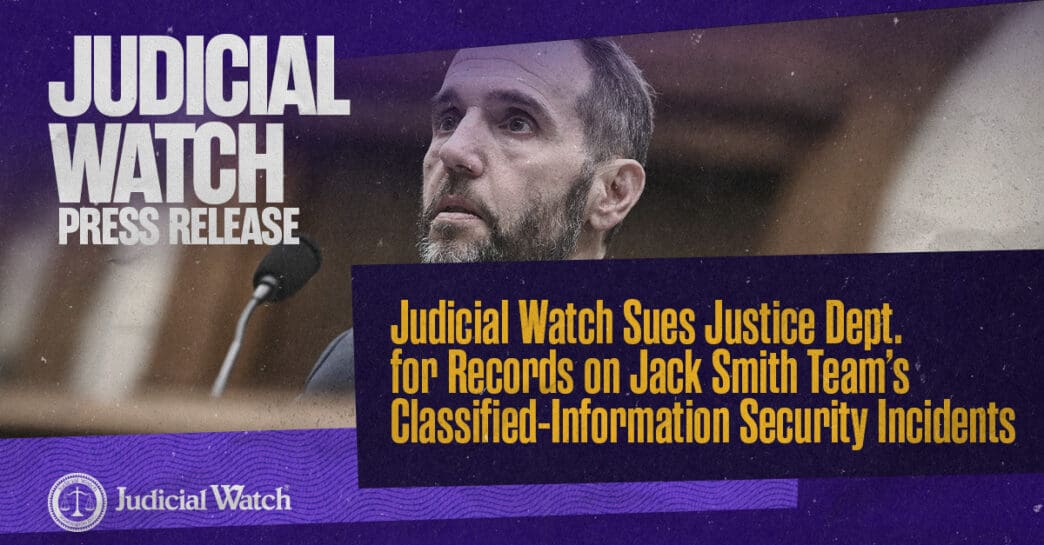
(Washington, DC) – Judicial Watch announced today that it filed a Freedom of Information Act (FOIA) lawsuit against the U.S. Department of Justice (DOJ) for records of security incidents, classified-material handling, and potential security violations involving former Special Counsel Jack Smith and members of his investigative team (Judicial Watch Inc. v. U.S. Department of Justice (Case 1:26-cv-03923)).
The lawsuit was filed after the Office of Information Policy failed to respond to Judicial Watch’s July 10, 2026, FOIA request for communications between senior Justice Department officials and Smith’s office concerning alleged classified-information security incidents, including Sensitive Compartmented Information Facility (SCIF) access, security violations, classified-material handling, security assessments, and any related investigations or disciplinary actions. The request specifically identifies six members of Smith’s team: Carli Rodriguez-Feo, Julie Edelstein, William O’Neil, Stephanie Van Buskirk, Molly Gaston, and Thomas Windom.
On July 8, 2026, Sen. Chuck Grassley (R-IA), chairman of the Senate Judiciary Committee, sent a letter to then-Acting Attorney General Todd Blanche about text messages among personnel in Smith’s office that raised concerns about multiple potential security failures involving classified materials during the time the Biden Justice Department was prosecuting President Trump for allegedly mishandling classified documents.
Messages from July 2023 indicate that investigators may have provided individuals access to classified materials without first confirming they had the required “need to know.” Other communications from October 2023 concerned a classified letter that had been left out. In an April 2024 exchange, personnel discussed a SCIF accessible to Smith’s team that had been left open overnight, resulting in what one Justice Department employee described as a security “violation and incident.”
In 2023, Smith brought two federal prosecutions against then-former President Donald Trump: one over his alleged handling of classified documents and another over his challenge to the 2020 election results. Both cases were dismissed before Trump returned to the White House in January 2025.
“Jack Smith’s prosecution team appears to have had serious security failures involving classified evidence,” said Judicial Watch President Tom Fitton. “The Justice Department must answer whether it applied the same standards to its own personnel that it sought to impose on President Trump.”
Before his appointment to investigate and prosecute Trump, Smith previously was at the center of several other controversial issues, the IRS scandal among them.
Judicial Watch is a national leader in exposing the lawfare and abuse targeting Trump and other American citizens.
In June 2026, Judicial Watch sued the Justice Department for records concerning meetings between Smith and members of his team and two Obama-appointed federal judges who presided over matters involving Trump.
In May 2026, Judicial Watch obtained records that revealed the FBI’s concerns about the legal basis for the 2022 raid of Trump’s Mar-a-Lago home. The records exposed explicit objections from field agents who warned the Justice Department that the unprecedented raid on Trump’s home lacked probable cause.
In April 2026, Judicial Watch sued the Justice Department for records on the Biden FBI’s search warrants used in the April 2021 raid on former New York City Mayor Rudy Giuliani’s residence and office (Judicial Watch Inc. v. U.S. Department of Justice (No. 1:26-cv-01158)). Giuliani served as a personal attorney and informal adviser to President Donald Trump.
In March 2026, the Justice Department reported that the FBI found about 1.9 million pages of records that are responsive to Judicial Watch’s FOIA lawsuit. These documents were reportedly stored in a “hidden room” at FBI headquarters and were first revealed by former Deputy Director Dan Bongino (Judicial Watch v U.S. Department of Justice (No. 1:25-cv-04047)).
In March 2026, Judicial Watch sued the Justice Department for records from the FBI’s Biden-era “Arctic Frost” probe, specifically involving the Criminal Division, the Office of Information Policy, Attorney General Merrick Garland, Deputy Attorney General Lisa Monaco and Special Counsel Jack Smith’s team (Judicial Watch, Inc. v. U.S. Department of Justice (No. 1:26-cv-00746)).
In March 2026, Judicial Watch asked a Georgia state court to reject Fulton County District Attorney Fani Willis’ efforts to continue hiding records about her office’s communications with Jack Smith’s office and the January 6 Committee (Judicial Watch Inc. v. Fani Willis et al. (No. 24-CV-002805)).
In February 2026, Judicial Watch secured the release of rosters identifying the names of top deputies who worked for former Smith (Judicial Watch Inc. v U.S. Department of Justice (No. 1:23-cv-01485)).
In January 2026, Judicial Watch sued the Justice Department for communications of FBI agents regarding the prosecution of former Trump trade advisor Peter Navarro (Judicial Watch Inc. v. U.S. Department of Justice (No.1:26-cv-00079)).
In January 2025, a federal court ordered the Justice Department to provide Judicial Watch information on communications between Jack Smith and Fani Willis regarding the prosecution of Trump. In May 2025, the Justice Department was directed to search text messages from the Special Counsel’s Office for responsive records (Judicial Watch v. U.S. Department of Justice (No. 23-cv-03110).