



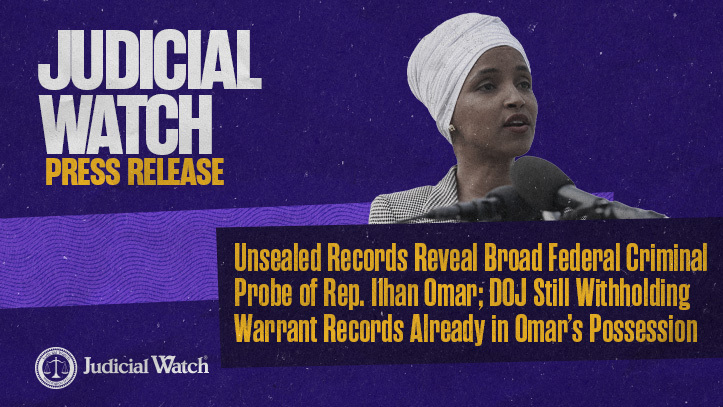
(Washington, DC) – Judicial Watch announced additional findings today that unsealed court records in its lawsuit over the October 12, 2026, search of Rep. Ilhan Omar’s (D-MN) Washington, DC, residence confirm a serious, wide-ranging federal criminal investigation of the congresswoman covering conduct from “1980 to the present.” The records also show that the U.S. Department of Justice continues to withhold a significant portion of the search warrant, its attachments, and the inventory of what agents seized, records that Omar and her lawyers already have copies.
The records were released on November 23, 2026, by order of Chief Judge James E. Boasberg in the consolidated unsealing proceeding brought by Judicial Watch, The New York Times, and fourteen press organizations (In re Application of Fourteen Press Organizations for Access to Sealed Search Warrant Records, No. 1:26-mc-00144 (D.D.C.)). While all three groups requested that the government file copies with Judge Boasberg to review, only Judicial Watch requested that the government also produce redacted versions of the records. More than half of the 169 pages released are entirely blacked out.
The partially unsealed records show a serious criminal investigation concerning conduct going back decades:
- The investigation reaches back more than four decades. The warrant authorized a search for evidence of multiple “Target Offenses” involving “Ilhan Nur Said Elmi a/k/a Ilhan Abdullahi Omar,” occurring “between 1980 to the present.” The Justice Department told the court it believes Omar “has committed” crimes “over decades,” beginning long before she entered Congress. The specific statutes remain redacted.
- A federal judge found probable cause. Magistrate Judge Matthew J. Sharbaugh pressed the government for more on probable cause for two of the offenses before signing. The Justice Department responded that its application “supplies probable cause related to each of the Target Offenses, not just the two the Court flagged,” and the court signed the warrant on October 9, 2026.
- The magistrate judge held the warrant for a week. The Justice Department applied at approximately 10:33 a.m. on Friday, October 2, 2026, and asked the court to sign by Monday, October 5. After “several inquiries” from the government about the status, Judge Sharbaugh said he would get to it on October 6. That day, he raised the Speech or Debate Clause problem on his own, ordered two rounds of supplemental briefing, and required revisions to the warrant before signing it on October 9. None of the October 2 through October 6 activity appears on the court’s docket, which begins on October 7.
- Senior Justice Department officials are directly involved. The government’s filings are signed by an Associate Deputy Attorney General as well as senior leadership from the U.S. Attorney’s Office. The Acting Deputy Attorney General, the second most senior official at the Justice Department, personally handled outreach to the House before the search.
- Agents were authorized to seize Omar’s phones, computers, and records. The warrant reaches cellular phones “registered to or used by” Omar, computers and storage media, and any digital device “owned, used, or controlled by” Omar “or in proximity to evidence of the TARGET OFFENSES.”
- Others may be implicated. In seeking secrecy, the government warned that disclosure could prompt “potential subject(s)” to flee, destroy evidence, or “influence or intimidate potential witnesses.” The records do not say who else is under scrutiny.
- The investigation is ongoing and active. Homeland Security Investigations executed the warrant at approximately 6:05 a.m. on October 12. On October 16, the Justice Department told the court its investigation “is still in full swing.” On November 4, it said the warrant is still “not fully executed.”
- The court imposed special constitutional protections over DOJ’s objection. The Justice Department argued the Speech or Debate Clause did not apply to a search of Omar’s home. Judge Sharbaugh disagreed and required a special search protocol, Attachment C, before signing.
- The Justice Department pointed to an earlier, broader warrant against someone else. To argue for fewer protections, the Justice Department told Judge Sharbaugh that “[t]he Court recently signed a broader search warrant with fewer protections.” That warrant, signed weeks earlier, reached “the person, devices, and two private Washington, D.C. residences” of someone whose name is redacted, and included “zero special Speech or Debate procedures.” In making the comparison, the Justice Department cited authority that Speech or Debate immunity remains “available to a Member of Congress after he leaves office,” suggesting the earlier target was a current or former Member of Congress. A signed search warrant package attached as an exhibit to DOJ’s first brief, apparently from that search, is fully redacted.
“Judicial Watch’s work paid off – as now the public has more details on the serious criminal issues concerning Ilhan Omar,” said Judicial Watch President Tom Fitton. “Also concerning is the court’s unusual delay of the search warrant and other unusual special protections for Rep. Omar.”
Judicial Watch’s investigation of allegations concerning Omar dates to July 2019, when it submitted an ethics complaint seeking an investigation into allegations involving perjury, immigration and marriage fraud, tax fraud, and student loan fraud.
Judicial Watch previously forced the release of a heavily redacted affidavit supporting the August 2022 search of President Trump’s Mar-a-Lago home. It also helped secure the unsealing of records concerning the FBI’s September 2022 seizure of Mike Lindell’s cellphone.
Judicial Watch has also moved to unseal warrant materials targeting Rudy Giuliani, Victoria Toensing, and Michael Caputo.
###